Table of Contents
How One Bad Review Can Cost You Customers (And How ORM Fixes It)
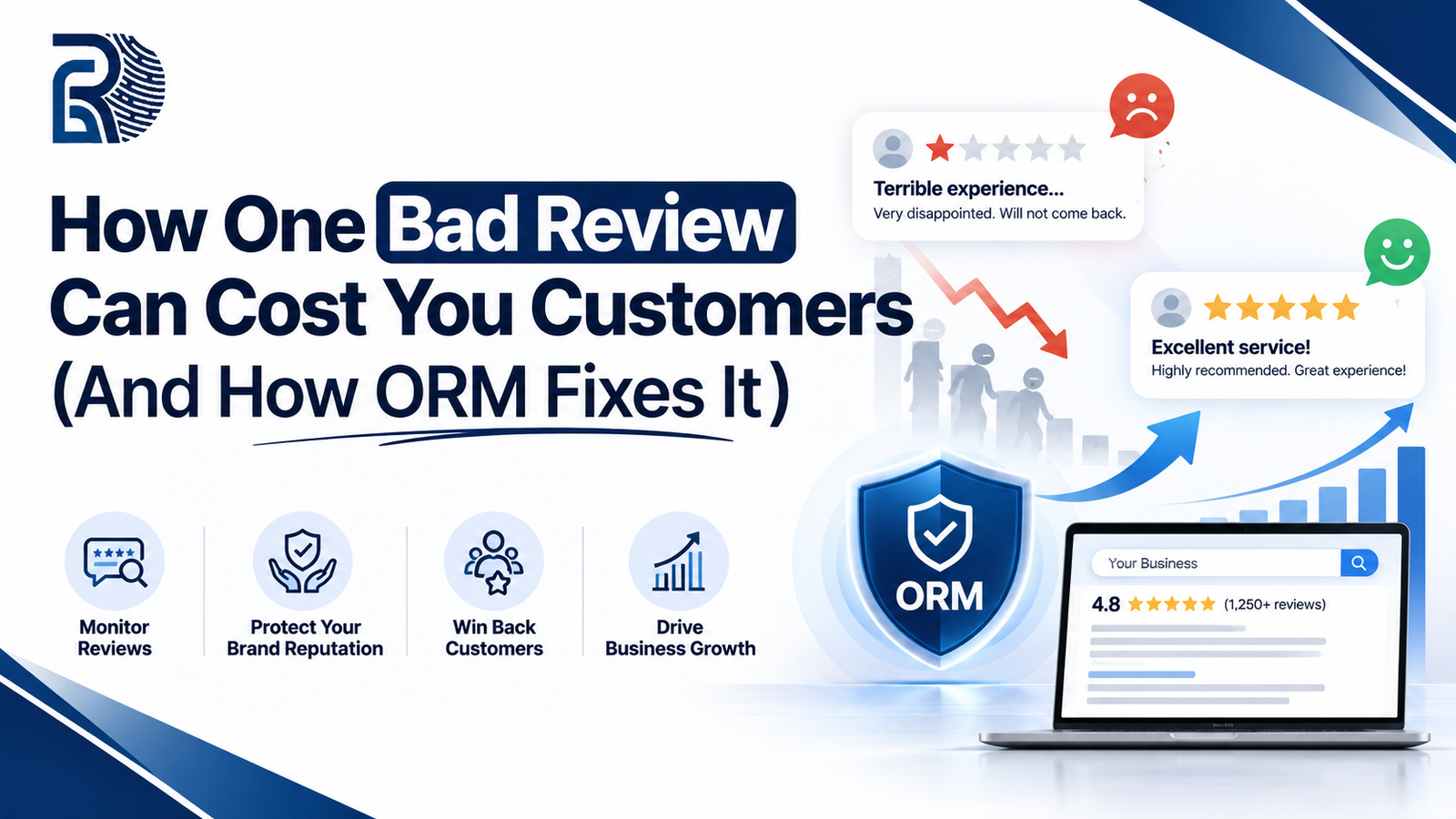
An interested customer types your business's name into Google. When they visit your site, as well as your opening hours or the best of your work, they are shown three stars and a comment that reads "never again." That's it. This is the first impression you've made in less than four seconds, but you didn't even get the chance to present your point.
It's the silent cost that many entrepreneurs overlook. A bad review is rarely confined to a single loss. It affects how others will perceive what you are, long before they've even talked to you for any inrjkd nh time. This is precisely why Online Reputation Management has stopped being just a "nice to have" and has become an integral component of how businesses are able to safeguard their revenues. In Rapid Digital Growth, we've seen this trend occur across numerous different industries. The solution isn't difficult to implement. The only thing that is required is the proper ORM approach that's consistently followed.
Why a Single Review Carries So Much Weight
Reviewers aren't just a source of feedback anymore. They're now the best way to trust. The world is busy, and they make use of star ratings as well as recently posted comments to make quick decisions instead of researching each option on their own. If someone is confronted by a strong and unresolved issue on top of their profile, the brain isn't processing this as "one opinion out of many." The brain interprets it as an opportunity. Risk is a thing that people are more likely to avoid than to pursue the reward.
This is further complicated by the fact that most businesses don't realize: Search engines and review sites often prioritize activities that are recent. A fresh review could outrank 10 positive ones due to the timing. Therefore, the harm isn't related to the number of bad reviews you've received; it's dependent on how prominent and current they appear.
The Real Cost of Ignoring Your Online Reputation
The financial consequences of a tarnished reputation seldom appear in a single moment. The effect is an ongoing leak
- A decrease in calls and form completions, without a clear justification for this.
- Conversion rates of ads are lower while the target isn't changing
- Sales cycles are longer because potential customers "want to think about it" when they have viewed your profile on the internet.
- The difficulty of hiring the best talent as candidates look up employers, similar to how customers search for suppliers
Many business owners are focused on the marketing aspect (more customers, more efficient advertising, or new campaigns) and don't even realize their name is what's draining the bucket. There's no reason not to pour more visitors into the top of the funnel; however, when a bad search result or an array of negative reviews is at the bottom, some of the visitors simply disappear.
What Online Reputation Management Actually Involves
The common belief is that ORM services are just focused on "hiding bad reviews" or "buying fake five-star ratings." This isn't reputation management; it's a risk to reputation. Genuine Online Reputation Management is an ongoing and structured procedure that is based on a handful of key pillars
Monitoring - Tracking mentions of your company on Google and other specific platforms for industry, social media, and the results of searches in real time to ensure that nothing goes in the dark for long periods of time.
Response strategy - Responding to feedback that is negative by using a calm, focused, precise, and solution-oriented tone, and in a manner which reassures readers instead of escalating the initial complaint.
Review generation - Making it simple and easy for customers who are satisfied to share their feedback. Your reviews reflect the actual quality of service, rather than just your loudest reviews.
Search result shaping - Stimulating the positive, owned, and neutral content that is ranked with your company's name, so that one negative piece of content or article isn't the main page.
Crisis containment - Having the right plan of action for when things go viral or get spread rapidly, which means that the action is swift and coordinated instead of being reactive and dispersed.
A Practical Framework for Handling a Bad Review
In the event of negative feedback in the business world, many owners dismiss it because of anger or react emotionally, and then regret it. Both of these actions can backfire. This is the process we guide our clients through:
- Pause before responding - Take the time to read through the review before writing any response. An initial defensive response almost always doesn't read well to non-professional observers.
- Verify the claim internally - and verify what happened prior to responding, ensuring that your response is precise and isn't easily disputed.
- Respond publicly, resolve privately - Recognize the problem in your public response. Then, invite the reviewer to contact you directly (phone or email) to discuss the details.
- Keep it short and human - Keep it short and human. Long responses are read as if they're guilty. A couple of authentic sentences are read as confident.
- Follow-up for a possible revision - Reviewers are willing to revise or delete reviews after the problem is resolved. However, only when you request.
Choosing the Right ORM Agency
Each ORM Agency operates in the same way. The differentiating factors are important. Certain agencies rely solely on suppression strategies that provide quick-fix solutions without considering how negative feedback is able to keep showing up. An improved ORM Agency treats reputation as a dual issue: optimizing the overall customer experience and also ensuring that the customer experience is presented on the internet.
If you are evaluating a company, be sure to ask the following questions directly: What are they doing to generate real reviews that aren't in violation of guidelines of the platform? How do they respond to criticism? Are they able to provide reports that track the evolution of sentiment over time, and not only images of star counts? A group like Rapid Digital Growth builds reputation strategies based on these tenets and treats ORM as a continuous discipline instead of a single cleanup initiative.
Building a Reputation That Works For You, Not Against You
Companies that deal with this effectively don't have to wait for an emergency. They integrate review creation and monitoring into their routine activities, in the same manner they monitor sales or site traffic. Continuous flow of new authentic reviews does more than appear better, but also blocks the effects of the occasionally negative reviews, as the new users can see them in an appropriate context instead of being viewed as a single warning flag.
Key Takeaways
One bad review is never a singular event, and it influences the way future customers view your business's overall image prior to them ever speaking with your company. Companies that are able to protect their revenues are active in controlling their online presence by keeping track of mentions, resolving them thoughtfully by generating real feedback, and determining what appears on the search engine. This is the foundation of successful Online Reputation Management, and it's not a quick fix.
If the reviews you've posted or the results of your search are causing problems for your clients, it's worth engaging in a serious discussion on what you can do to fix it. Rapid Digital Growth works in partnership with businesses to create ORM strategies tailored to their particular industry and business goals. We transform reputations from being a burden into an asset to support development instead of hindering it.