Table of Contents
Why Does Your SEO Strategy Stop Working After Every Google Update?
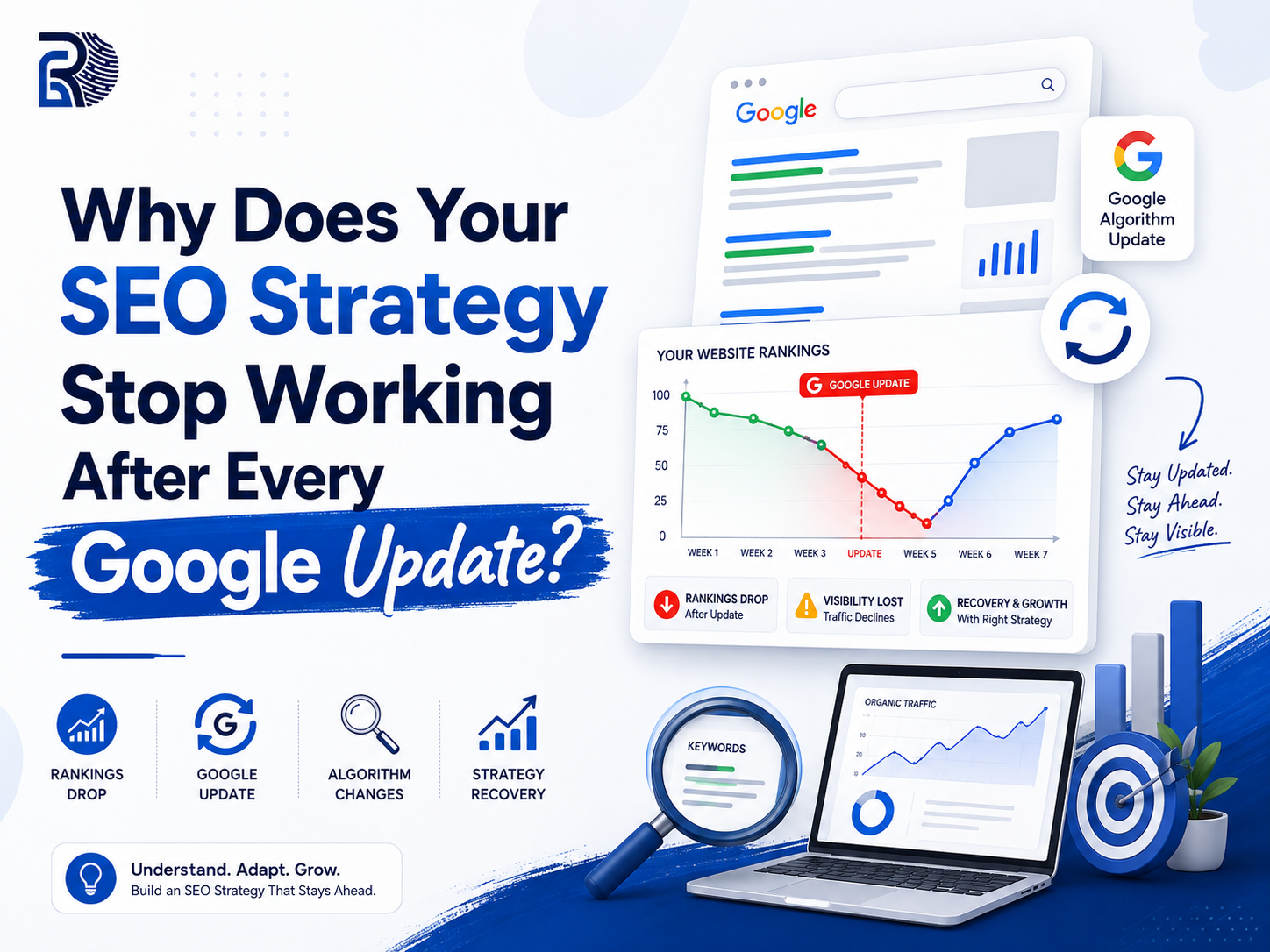
It's finally time to find your pattern. Traffic increases, rankings increase, and leads are generated automatically. And then Google releases an update in a matter of days; your top-performing websites lose 30 percent of their visitors without a reason that you could use in your own blog posts. If you're feeling like this is a familiar scenario, it's not just a coincidence or anything. You're not the only one. A majority of SEO strategies don't have to be damaged due to Google updates. They've been vulnerable even before the update was released, but the update just revealed it.
The Real Reason Updates Feel Like Punishment
There's a shocking truth that the majority of SEO tips don't mention: Google updates rarely target the user specifically. They redefine the notions of what "quality" and "relevance" refer to across the web, and every strategy based on shortcuts or preconceived notions is recalibrated with the update. If your ranking was heavily based on one strategy, thin text stuffed with keywords, numerous low-quality backlinks, or websites that are optimized to meet a specific small search, then the update shouldn't directly penalize you. The only thing that's needed is not to reward the things that you relied upon. It's like a sudden drop in traffic; however, the risk was there before.
Three Patterns That Make an SEO Strategy Update-Fragile
After reviewing a myriad of sites that suffered a decline post-update, three identical patterns are found repeatedly.
Single-intent pages
The page that is written with the sole purpose of an informational search may be a problem when Google interprets the query to be a navigational or commercial one also. Your page isn't devalued; the page was just not providing the complete picture Google is now expecting.
Engagement debt
Pages that are ranked with respect to backlinks and keywords on their own, but do not retain readers' attention, create what I refer to as the debt of engagement. Google's algorithms increasingly consider the way users act after clicking the result. The page that is hit but then subsequently deleted can be a problem waiting for an algorithm change to signal it.
Content built for search engines first.
Writing articles to meet the word count or keyword density, instead of in a genuine attempt to answer a problem better than everyone else, will likely be able to endure until Google's models become better at distinguishing the two. Google's models are constantly becoming better at detecting the differences.
Why "Just Follow Best Practices" Isn't Enough Anymore
Many SEO information online refers to top practices as a predetermined guideline: optimize your titles, create backlinks, post consistently in a consistent manner, and so on. It's not incorrect; however, it's wrong due to the assumption of stability, which is no longer the case. The Google ranking system relies heavily upon machine-learning models which continuously adjust based on the actual behavior of users rather than static indicators which you are able to manipulate once and put away. Any strategy that views SEO as a once-in-a-lifetime process instead of an ongoing process is, by definition, an unsustainable SEO strategy the moment it's over.
A Framework for Building an Update-Resistant Strategy
Instead of reacting to every Google update after the damage has already been done, design your strategies around resilience starting from the beginning. Here's the structure I use to guide my clients through:
1. Diversify coverage of search intent
If you have a priority topic, don't simply answer the simple inquiry. Be sure to address the subsequent questions as well as the type of comparison that a buyer might make, as well as an objection that skeptical readers could ask. It protects you if Google redefines what the word "really" means.
2. Check for engagement, not only rankings
Check your Analytics and search at pages that get a lot of impressions but low time-on-page, or high bounce rate. These are the update-risk pages regardless of where they're currently ranking. Repairing the content gap before an update causes the problem.
3. Rebuild your content based on demonstrated competence
Every page should be evident that a person with experience wrote the content. First-hand experiences, original examples, and precise detail are much more difficult for an algorithm to value over a generic summary, as they're much more difficult to reproduce on a mass scale.
4. Consider health and technical maintenance as a routine for the month rather than a "launch" task
Broken redirects, slow-loading pages, or blocked crawl paths slowly erode your foundations during an update. The quarterly review of technical issues will catch these issues before Google's crawlers do.
5. Create authority outside of the SERP
The brand's name that appears in publications of the industry, is mentioned through social networks, and is searched by name is more difficult for any one algorithm to completely erase. Rankings are just one indicator in a sea of signals, but they are however, they are not the entire scoreboard.
Common Mistakes That Undo Good SEO Strategy
Even experienced marketers slip into several traps that can be avoided following a drop in ranking. The same tactic was successful in the case of a competitor without making sure it is compatible with the history of your site; usually backfires. Rapidly publishing large amounts of fresh content in an attempt to "recover fast" tends to reduce the quality of your site. While ignoring pages that have been underperforming since the home page is ranked well, let new updates discover new vulnerabilities that you were already aware of.
When It's Time to Bring in Outside Expertise
Determining if the drop is the result of an update, an error on the part of the tech, or an actual content gap requires an understanding of patterns that is difficult to establish without witnessing that it happens across a number of websites. This is exactly how a specialized SEO service earns its reputation, not through the pursuit of algorithms, but rather by implementing a multi-layered and resilient plan that can stand up no matter what Google is going to do next.
Building SEO That Doesn't Flinch at the Next Update
Google continues to evolve. It's not just a situation to be awaited, and it's a permanent condition for SEO professionals from 2026 onwards and beyond. Strategies that last aren't necessarily the best ones; they're the ones that have the greatest durability with broad intent coverage, real expertise, solid technological foundations, and an authority that extends over the results of a search. Review your top-traffic websites against the patterns of fragility below, and then fix the issues you discover before the next update, identifying the issue for you. If you'd prefer another set of experienced observers to look over your audit, this is exactly what the foundation Rapid Digital Growth builds strategies around.