

No headings found
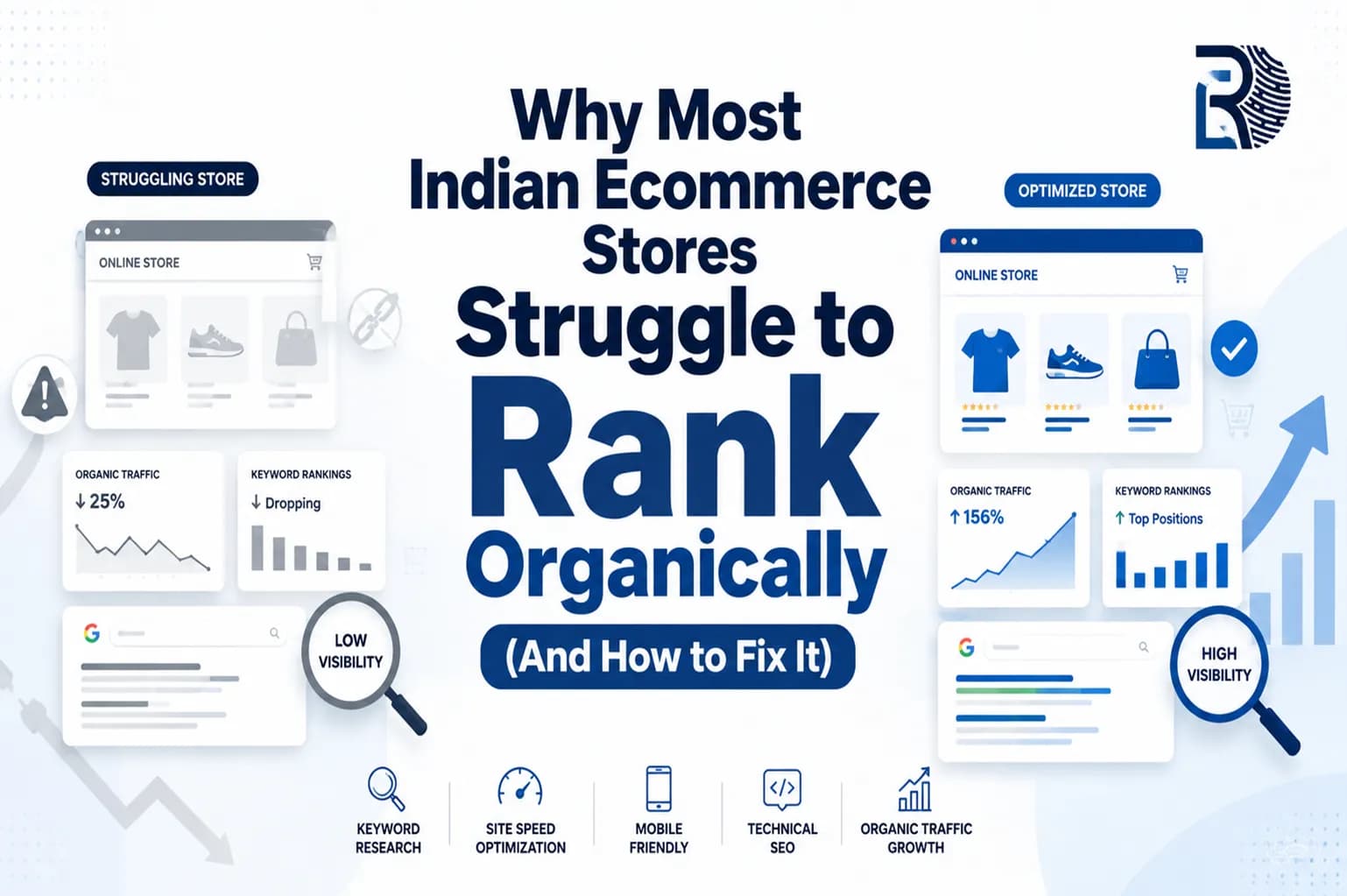
Ads that are paid for on Google or Meta will generate traffic until the budget runs out. Once the budget is exhausted and the traffic stops, it will cease. For the hundreds of companies that are seeking to create a sustainable business model, this type of dependence is costly and risky. A different approach, establishing an SEO as an organic search engine through SEO can take longer to yield results, yet it increases more quickly than paid advertisements will never be able to.
Selecting the best Ecommerce SEO Agency in India and knowing the fundamentals behind what is working in the SEO landscape is an important decision that will determine the overall direction for an online shop. This guide outlines the tactics that can actually improve search results for online retailers and also explains what the major mistakes are, prior to identifying a solution that is effective.
A majority of the SEO guidance on the internet is designed in the context of Western markets with an eye towards Western markets. Google US, European audiences, English-language searches. The online marketplace has distinctive particularities that call for a customized method.
The majority of searches in India originate on websites such as Amazon India, Flipkart, and Meesho instead of Google. Therefore, efficient Ecommerce SEO services in India should consider both Google market visibility and search rank in tandem. If a product is ranked highly on Google, but has no marketplace optimization will not be able to capture an enormous portion of the market as well.
The search queries of India are also a reflection of a multilingual world. Hindi, Tamil, Telugu, Bengali, and Marathi people are now increasingly using their home languages, especially with mobile devices. The stores that are optimized for English search terms have left a significant amount of organic traffic unaccounted for.
The most frequent technical issue in eCommerce websites is insufficient or redundant product information. Many online sellers either use manufacturer-provided descriptions or allow the same description to appear across multiple product variants with slightly different parameters. From the perspective of search engines, it creates pages that are identical but not unique.
Google does not punish duplicate content by an action that is manual in the majority of instances; however, it will remove pages with nothing other than what is already present on more established, more secure websites. If a brand new or medium-sized online store releases the manufacturer's copy, which is found on more than a dozen different websites, it is unable to compete with the competition for ranking on almost all of the occasions.
It's simpler than you think. The original product descriptions, which reflect what consumers actually think about their search results for items that are written in specific terms that correspond to real searches, significantly increase the rank potential of product pages. This is the foundation of any efficient e-commerce SEO method.
Although product pages can be important introductions, category pages are typically targeted at more popular keywords and have significantly greater SEO authority. A category page that is targeted for "men's formal shoes under 2000" is able to draw constant traffic on a scale that no single product page is able to compete with.
A common mistake eCommerce stores make is treating categories as a simple navigational grid of items with nothing more. For a category page to be ranked organically, the page must have an introduction that explains the topic it is about, internal links to the subcategories of interest, and well-organized content that can answer consumers' questions when they are deciding which product to purchase.
A short, well-written, and concise introduction to a page for a category, as little as 100-150 words, coupled with a simple design and an organized navigation system that does not generate duplicate URLs, can transform categories from being inaccessible to a competitive position in just a couple of months.
India is among the top smartphone internet use rates around the globe,e as the bulk of shopping and e-commerce takes place on mobile devices, typically with mid-range models and varying internet speeds. An online store that loads quickly on a computer but runs unresponsive or not visually appealing on a less expensive Android device will be inaccessible to many potential buyers.
Google's Core Web Vitals now directly impact search ranking. The thresholds for the largest contentful paint, Cumulative Layout Shift, and interaction to Next Paint are stricter than what the majority of eCommerce sites are currently meeting. Optimization of images, delayed loading of non-critical scripts, and response times for servers are realistic starting points that the majority of stores can enhance without rebuilding the entire website.
Anyone serious about Ecommerce SEO services in India needs to include a thorough technical inspection as the initial process, since the structural and performance problems within the website can be a reason why keywords and content do not produce the desired positive results.
The market for digital marketing has been growing rapidly, as has the number of companies that claim to be experts in e-commerce SEO. One of the challenges for companies operating online is to distinguish between those who truly understand the fundamentals of organic search and those offering ranking of keywords in a way, but do not consider whether the ranking translates to revenue.
A reputable Ecommerce SEO Agency in India will be able to define the relationship between the health of your site's technology and the potential for ranking. Create a keyword strategy that is based on real buyers' intent instead of general keyword volumes and provide past instances of the growth in organic traffic due to specific actions, not variations in seasonality.
The report should contain keywords, the organic sessions rate of conversion of organic traffic, and the revenue that is directly linked to the search. The rankings alone do not provide a complete report.
Organic search is among the very few channels for marketing where an investment that is consistent over time will grow instead of resetting every month. In the case of eCommerce businesses, there is a real opportunity;y however, it is necessary to get the foundations right. That means unique categories and product content, technological performance that is compatible with the requirements of mobile devices, and a search engine optimization strategy that reflects the way customers actually use search.
Rapid Digital Growth works in partnership with eCommerce businesses to improve their visibility on search engines, which can generate steady revenue. It ranges from technical audits and on-page optimization to a long-term strategy for content. The way to reduce the dependence on funds begins with knowing what is causing organic growth to be hindered, and it is clear that this is possible faster than store owners anticipate.
 SEO
SEOThe decision-making process between paid and SEO is usually based on the goals you have in mind, your budget, and timing.
Read More SEO
SEOLocal SEO helps businesses improve their online visibility, attract nearby customers, and increase foot traffic by optimizing for location-based searches.
Read More SEO
SEOA well-optimized Google My Business profile boosts local SEO, increases visibility, attracts customers, and helps businesses rank higher in local searches.
Read More